
Best POS Workflow for Fast Counter Billing in Busy Indian Stores
Learn how busy Indian retail stores can speed up POS billing, reduce checkout errors, manage multiple billing counters and improve customer checkout experiences.
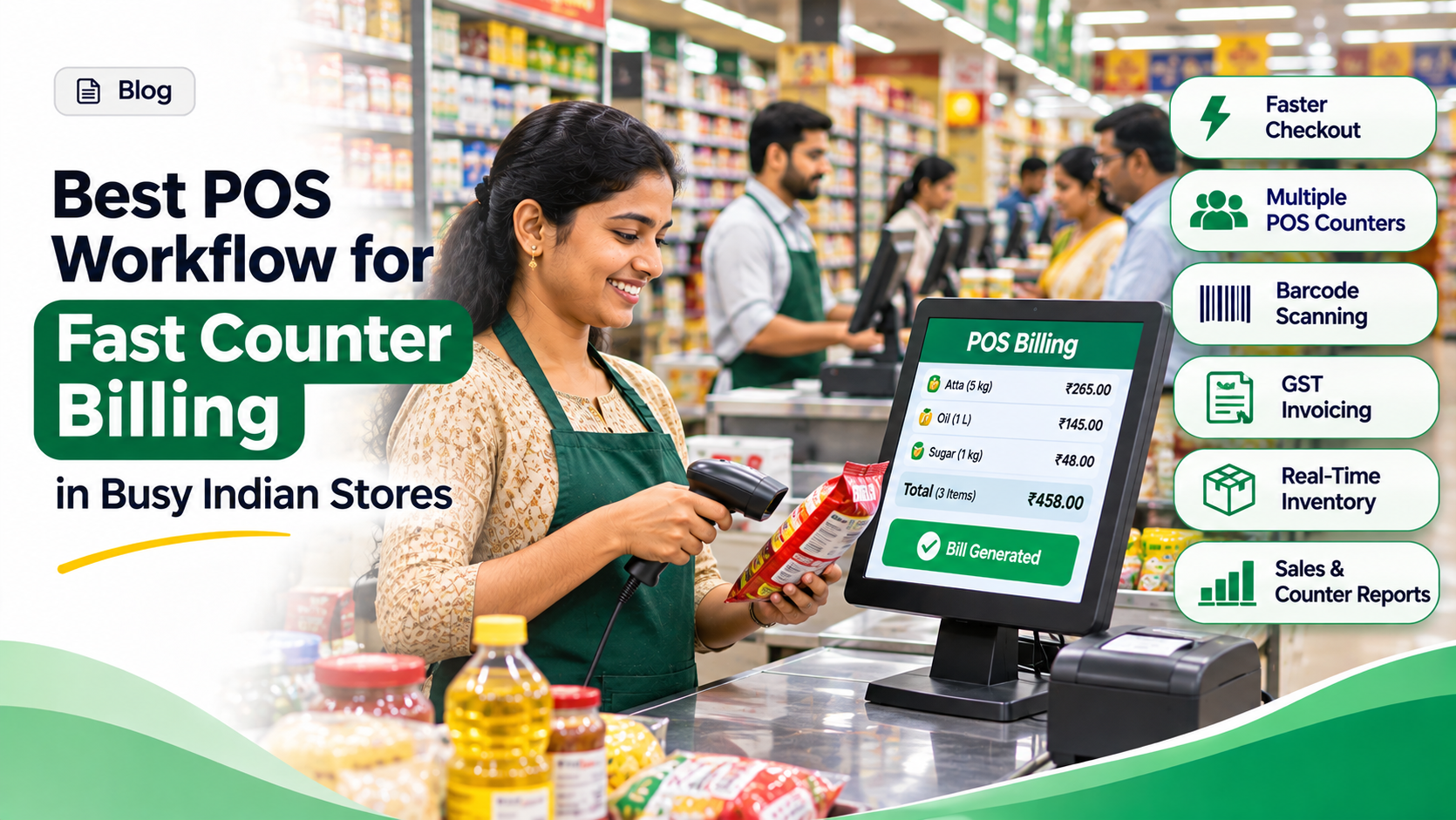
Best POS Workflow for Fast Counter Billing in Busy Indian Retail Stores
A fast POS billing workflow helps busy Indian retail stores serve customers quickly, reduce billing mistakes and manage daily sales more efficiently. The key is to maintain an organized product catalogue, select products quickly, verify quantities, process payments smoothly and generate invoices without unnecessary steps. With the right POS billing software and trained employees, retailers can make checkout faster without compromising accuracy.
Whether you operate a kirana store, supermarket, hardware shop, electrical store, medical shop or tiles showroom, an efficient billing counter is essential for daily business operations.
During peak hours, even a few extra seconds per transaction can create long queues. Employees may struggle to find products, enter incorrect quantities or handle payments while customers wait.
A well-designed POS workflow solves these problems by making every billing step simple, consistent and repeatable.
In this guide, let's explore how Indian retailers can improve counter billing speed and accuracy.
Quick Answer: What Is the Best POS Workflow for Fast Billing?
A practical POS billing workflow follows these steps:
1. Open the POS billing screen. 2. Select the customer or use the default walk-in customer workflow. 3. Search for products or scan barcodes where supported. 4. Add products and verify quantities. 5. Apply authorized discounts, if applicable. 6. Review the invoice total and applicable GST. 7. Select the customer's payment method. 8. Complete the payment entry. 9. Generate and print or share the invoice. 10. Allow the system to update sales and inventory records.
The objective is to eliminate unnecessary steps while maintaining billing accuracy.
1. Why Is Billing Speed Important for Retail Stores?
Retail customers generally expect quick service, particularly when purchasing a small number of products.
A slow billing process can create:
- Long queues during peak hours.
- Customer dissatisfaction.
- Increased workload for employees.
- Repeated product selection mistakes.
- Delays in payment collection.
- Difficulty managing multiple customers.
Consider a grocery store handling 100 customer transactions per day.
If employees spend an additional 15 seconds on every transaction because of an inefficient billing process, the store loses 25 minutes daily just waiting for unnecessary billing steps.
This is why optimizing the checkout process matters.
2. Prepare Your Product Catalogue Before Billing
An organized product catalogue is the foundation of an efficient POS workflow.
If employees cannot find products quickly, billing becomes slower.
Before starting daily operations, ensure your product database is properly organized.
| Product information | Purpose |
|---|---|
| Product name | Quick product identification |
| Category | Easier product organization |
| SKU or barcode | Faster product identification |
| Selling price | Accurate billing |
| Unit of measurement | Correct quantity entry |
| GST rate | Correct tax calculation |
| Available stock | Inventory visibility |
For example, a hardware store may sell multiple types of screws, pipes and electrical accessories.
Using clear product names and categories helps employees select the correct item without repeatedly searching through an unorganized list.
**Best practices:**
- Use consistent product names.
- Avoid duplicate product entries.
- Organize products into meaningful categories.
- Maintain updated selling prices.
- Verify applicable GST settings.
- Configure barcodes where applicable.
3. Follow a Standard POS Billing Workflow
Every employee operating the billing counter should follow a consistent process.
Step 1: Open the billing screen
Employees should be able to access the POS billing interface quickly without navigating through unrelated menus.
Keep the billing workflow simple and ensure employees know where to find essential controls.
Step 2: Select the customer
For regular customers, selecting the correct customer record helps maintain organized transaction history.
For walk-in customers, use the appropriate default customer workflow when supported.
Avoid unnecessary customer-data entry when it is not required for the transaction.
Step 3: Add products quickly
Search for products using their names, categories, SKU or barcode where supported.
For frequently sold products, convenient product discovery can reduce repetitive searching.
Step 4: Verify quantities and prices
Before completing the bill, verify:
- Correct product selection.
- Correct quantity.
- Correct selling price.
- Applicable discounts.
- Applicable tax calculations.
A fast transaction is useful only when the invoice is accurate.
Step 5: Review the invoice
Check the subtotal, discounts, taxes and final payable amount.
Make corrections before completing the transaction whenever possible.
Step 6: Record payment
Select the applicable payment method, such as cash, UPI, card or another supported payment mode.
Record the amount received correctly and verify any outstanding balance.
Step 7: Generate the invoice
Complete the transaction and generate the invoice.
Print the bill or share it digitally with the customer where supported.
A consistent process reduces unnecessary movement between screens and makes employee training easier.
4. Use Multiple POS Counters During Peak Hours
A single billing counter can become a bottleneck when customer traffic increases.
Retail businesses with multiple employees or checkout stations can benefit from operating multiple POS counters simultaneously.
For example, consider a supermarket during evening peak hours.
| Counter | Responsibility |
|---|---|
| Counter 1 | Regular customer billing |
| Counter 2 | Additional checkout queue |
| Counter 3 | High-volume billing support |
Multiple concurrent POS counters help distribute transactions and reduce dependence on one checkout station.
When choosing billing software, verify that it can support the number of concurrent counters your business requires.
DVyapar supports unlimited concurrent POS counters, helping retail businesses operate multiple billing stations.
5. Reduce Manual Data Entry and Repeated Actions
Repeated manual entry can slow down checkout and increase the possibility of mistakes.
Retailers should identify unnecessary actions in their existing billing process.
Consider these improvements:
- Use saved product records instead of entering product information repeatedly.
- Use barcode scanning where supported.
- Organize frequently sold products for easier selection.
- Avoid unnecessary customer-data entry.
- Use configured GST rates instead of manually calculating taxes.
- Keep payment methods organized.
- Train employees to correct invoice details efficiently.
The goal is to reduce repetitive work without removing important verification steps.
6. Train Employees to Handle Busy Billing Counters
Billing software is only one part of an efficient checkout process.
Employees must also understand the billing workflow.
A simple training checklist can help new employees become comfortable with daily operations.
| Training area | What employees should learn |
|---|---|
| Product selection | Find and add products |
| Quantity entry | Enter correct quantities |
| Price verification | Check selling prices |
| Discounts | Apply authorized discounts |
| GST billing | Understand invoice tax details |
| Payments | Record payment methods |
| Invoice generation | Print or share bills |
| Corrections | Handle billing mistakes properly |
Conduct practical training using sample transactions before employees independently operate the billing counter.
7. Monitor Daily Sales and Billing Performance
An efficient POS workflow should also help the owner understand daily business activity.
Regularly review:
- Total daily sales.
- Number of invoices generated.
- Product-wise sales.
- Payment collection records.
- Discounts and returns.
- Stock movement.
- Employee transaction activity where supported.
For example, if sales increase significantly during evening hours, the store owner may consider allocating additional employees to the billing counter during that period.
Reports help business owners make better operational decisions.
8. How DVyapar Helps Retail Stores Improve POS Billing
DVyapar is cloud-based billing, GST invoicing and inventory management software designed for Indian retail businesses.
It helps retailers manage important checkout and business operations from one platform.
Fast POS billing
Create customer invoices using saved product records and a streamlined billing workflow. Billing in under eight seconds is possible for suitable, straightforward transactions, depending on the product catalogue and workflow.
Unlimited concurrent POS counters
Operate multiple billing counters simultaneously to support busy retail environments.
GST invoice generation
Generate invoices with configured tax calculations and applicable GST details.
Inventory updates
Maintain stock records as sales and purchases are recorded.
Multiple invoice templates
Choose from available invoice templates and configure invoice details to suit business requirements.
WhatsApp invoice sharing
Share invoices digitally with customers through WhatsApp.
Business reports
Review sales, profit, GST summaries and other business information to understand daily performance.
By combining POS billing, inventory tracking and reporting, DVyapar helps retailers organize their daily business operations.
9. POS Billing Counter Readiness Checklist
Before opening your billing counter each day, review the following:
- [ ] POS billing screen is accessible.
- [ ] Product catalogue is updated.
- [ ] Selling prices are verified.
- [ ] Applicable GST configurations are checked.
- [ ] Barcode scanners and printers are working, where used.
- [ ] Payment methods are ready.
- [ ] Employees understand the billing workflow.
- [ ] Multiple counters are ready where required.
- [ ] Invoice templates are configured.
- [ ] Previous transactions and pending corrections are reviewed.
Following this checklist helps reduce avoidable delays during business hours.
Frequently Asked Questions About POS Billing Workflows
1. What is the best POS workflow for retail stores?
The best POS workflow involves selecting products, verifying quantities and prices, applying discounts, calculating applicable taxes, recording payments and generating invoices through a consistent process.
2. How can I speed up billing in a busy grocery store?
Maintain an organized product catalogue, use barcode scanning where supported, train employees, reduce unnecessary data entry and use multiple billing counters when customer traffic increases.
3. How many POS billing counters does a retail store need?
The number depends on customer traffic, transaction volume, store layout and staffing. Businesses should add counters when existing checkout queues regularly become difficult to manage.
4. Can multiple employees use POS billing software simultaneously?
Yes. Suitable POS systems support concurrent billing operations. DVyapar supports unlimited concurrent POS counters.
5. Does POS billing software automatically calculate GST?
POS billing software can calculate applicable GST based on configured product tax settings. Retailers must ensure that their product classifications and tax configurations are correct.
6. Can POS software update inventory after every sale?
Inventory-enabled POS systems can update stock records when sales are completed. Accurate product and transaction entries are essential for reliable stock information.
7. Can I share retail invoices through WhatsApp?
Yes. DVyapar supports digital invoice sharing through WhatsApp, helping retailers send bills to customers conveniently.
8. How long should a POS billing transaction take?
There is no universal transaction time. It depends on the number of products, customer information, payment process and employee familiarity. A streamlined workflow can make straightforward transactions considerably faster.
Final Thoughts
A fast billing counter is not just about using faster computers or adding more employees. It requires an organized product catalogue, a simple POS workflow, trained staff and reliable billing software.
Retailers who optimize their checkout process can reduce unnecessary delays, improve billing accuracy and provide a better customer experience.
Whether you run a kirana store, supermarket, hardware shop, electrical store or another retail business, building a consistent POS workflow can make daily operations easier.
**Ready to simplify your retail billing?**
Explore DVyapar to manage POS billing, GST invoices, inventory, multiple counters and business reports in one platform.
FAQs
Frequently asked questions about Dvyapar
These answers stay the same across the site so readers get a clear product overview wherever they land.
Is DVyapar's online GST billing software suitable for small businesses?
Yes. DVyapar is built for retailers, wholesalers, distributors, and service businesses of all sizes. Its intuitive interface makes it easy for anyone to start using without technical expertise.
Why choose DVyapar over other GST billing software?
DVyapar focuses on simplicity, speed, and affordability. It combines billing, inventory, GST compliance, customer management, and business reporting into one easy-to-use platform, making it one of the best GST billing software in India for growing businesses.
Can I create GST invoices on DVyapar ?
Yes. DVyapar is one of the best GST bill invoice software. It lets you generate accurate GST-compliant invoices with automatic tax calculations in just a few clicks. In addition, you do not require any technical knowledge to learn it.
Can DVyapar help me manage inventory and purchases?
Yes, DVyapar's bill generator software can help you manage inventory and purchases easily. Every sale and purchase automatically updates your inventory, helping you maintain accurate stock levels and simplify inventory management.
Is DVyapar a cloud-based GST billing software?
Yes. As a secure online GST billing software, DVyapar allows you to access your business from anywhere without installing software. You can login with our credentials on the web or phone and access all the records and reports.
Do I need technical knowledge to use DVyapar?
No, you do not require any technical knowledge. DVyapar is built with simplicity in mind, making it easy for anyone to use. Its intuitive interface allows you to create invoices, manage inventory, and handle daily business operations.
Can I use Dvyapar on a phone?
Yes. The product is made to be usable on phone and desktop, so staff can work the way that suits the store best.
Can I share bills with customers?
Yes. You can print bills or share them digitally, including through common customer follow-up flows such as WhatsApp.
How do I get started?
Register here: https://app.dvyapar.com/register. Create your account, explore the product, and book a demo if you want help setting it up.
Is there a free trial?
Yes. You can start with a trial, try the main workflow, and see if it fits your shop before you move ahead.
How does pricing work?
Pricing is kept simple so you can compare the plan that matches your store size, billing counter, and support needs.
Can I manage multiple stores?
Yes. Dvyapar can support stores that want to keep more than one counter or location in a single view.
Does Dvyapar show reports?
Yes. You can check sales, stock movement, and daily business activity so the owner can review the store quickly.
Can I get help after signup?
Yes. You can book a demo or reach the team for setup help so the first day feels easier.